If you have ever looked around your home or workspace and thought, “It’s clean, but it still doesn’t feel clean,” you are usually looking at the difference between standard cleaning and a deep clean. When people ask what does deep cleaning include, they are usually trying to figure out whether they need a simple reset or a more thorough service that tackles the buildup regular cleaning misses.
A deep clean goes beyond surface-level tidying. It focuses on dirt, grease, dust, soap scum, and grime that collect in places most people do not have time to address every week. That includes baseboards, fixtures, corners, vents, behind furniture, bathroom buildup, and kitchen problem areas like stovetops and cabinet fronts. The goal is not just to make a space look better for a day. It is to restore a healthier, fresher baseline.
What does deep cleaning include in most homes?
In most cases, deep cleaning includes all the basics of a standard cleaning plus more detailed attention to neglected and high-touch areas. Floors are vacuumed and washed, surfaces are wiped, and bathrooms and kitchens are sanitized. The difference is the level of detail.
Instead of quickly wiping visible surfaces, a deep clean usually targets buildup in grout lines, around faucets, along baseboards, on doors and door frames, light switches, ceiling fans, vents, blinds, and other spots where dust settles over time. Furniture may be cleaned underneath or behind if it is safe and accessible to move. Trash areas, trim, and window sills often get the kind of attention they do not receive during routine visits.
That said, deep cleaning is not a single universal checklist. Some companies include interior windows, appliance interiors, wall spot cleaning, or inside cabinets by default. Others treat those as add-ons. That is why a clear service scope matters. A professional team should tell you exactly what is included before the appointment starts.
The areas that usually need the most attention
Kitchens
The kitchen is one of the biggest reasons people book a deep clean. It is also one of the hardest rooms to fully maintain without dedicated time. Grease settles on cabinet fronts, crumbs collect in corners, and food residue builds up around appliances faster than most people realize.
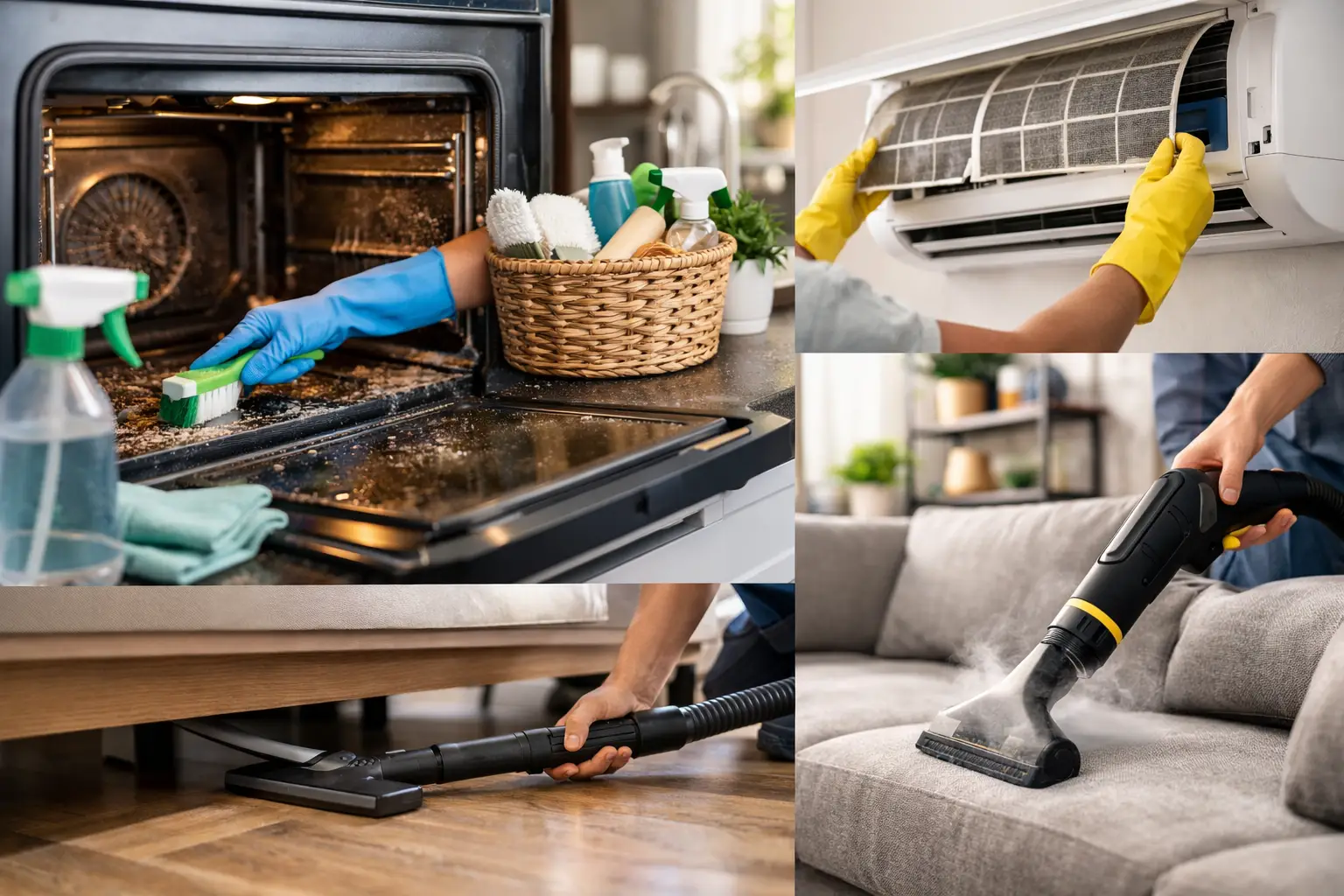
A proper deep clean in the kitchen usually includes scrubbing sinks and faucets, sanitizing counters, wiping backsplashes, cleaning the exterior of appliances, detailing stovetops, and removing grease from cabinet exteriors. Floors are cleaned carefully, especially near the stove, fridge, and garbage area where spills tend to hide.
Depending on the service, the inside of the microwave, refrigerator, oven, or cabinets may also be cleaned. These are common requests, but they are not always standard. If your main concern is appliance buildup, ask about it upfront rather than assuming it is included.
Bathrooms
Bathrooms show the value of deep cleaning quickly because they collect both visible mess and hidden buildup. A standard wipe-down can improve appearance, but it does not always remove soap scum, hard water marks, grime around fixtures, or residue around the toilet base.
Deep cleaning a bathroom usually includes scrubbing tubs, showers, tile, grout, sinks, counters, mirrors, toilets, and floors in greater detail. Special attention is often given to corners, edges, faucet bases, and areas behind or around the toilet where dust and moisture combine.
If mildew or heavy staining is present, results can depend on how long the buildup has been there and what surfaces are affected. Cleaning can improve many issues, but it does not always reverse permanent staining, damaged caulk, or worn grout.
Bedrooms and living areas
These spaces may look easier to maintain, but they collect a surprising amount of dust. Baseboards, blinds, ceiling fans, vents, lamps, shelves, and upholstered furniture all hold onto debris that routine cleaning often skips.
A deep clean in bedrooms and living areas usually includes dusting from top to bottom, wiping reachable surfaces, cleaning trim and door frames, vacuuming edges and under furniture, and washing hard floors. If pets are in the home, extra work may be needed to remove hair from corners, fabric surfaces, and along baseboards.
This is also where deep cleaning helps with overall indoor freshness. It is not just about appearance. Removing settled dust and debris can make a room feel lighter and more comfortable, especially in homes with kids, pets, or allergy concerns.
What deep cleaning does not always include
This is where expectations matter. People often hear “deep cleaning” and assume it covers everything in the property. In reality, some services fall outside normal deep-clean scope because they require extra time, specialized tools, or separate training.
Carpet shampooing, upholstery cleaning, pressure washing, post-construction debris removal, exterior window cleaning, mold remediation, and biohazard cleanup are usually separate services. The same can be true for heavy clutter removal or organizing. Cleaning teams can clean around items, but they are not always hired to sort belongings or haul things away.
There are also practical limits. If an area is blocked, unsafe, or too delicate to move, it may not be cleaned behind or underneath. Professional cleaners should protect your home, not risk damage just to reach every inch.
When a deep clean makes the most sense
Deep cleaning is often the right choice when a space has fallen behind, but that is not the only time to book one. It also makes sense before starting recurring service. A detailed first visit creates a clean baseline, and regular maintenance helps keep it there.
It is also useful before hosting guests, after a busy season, during spring cleaning, after illness in the household, or when moving in or out. Property managers and landlords often request deep cleaning between tenants because presentation and sanitation both matter. Business owners may schedule it before inspections, after remodeling, or when the workplace needs more than routine upkeep can provide.
For many people, the real value is time. Deep cleaning can take an entire weekend if you try to do it alone, and even then it is easy to miss areas. A trained team works faster, follows a system, and usually delivers more consistent results.
What does deep cleaning include for offices and commercial spaces?
In commercial settings, what does deep cleaning include depends on the type of business and how the space is used. An office, retail store, clinic, and shared workspace all have different traffic patterns and sanitation needs.
In general, a commercial deep clean focuses on high-touch surfaces, restrooms, breakrooms, floors, glass, fixtures, and detail areas that do not get enough attention during nightly or weekly maintenance. That can include disinfecting desks and phones, wiping partitions, deep-cleaning restroom fixtures, removing buildup in kitchenettes, and cleaning corners, vents, trim, and shared touchpoints.
For businesses, appearance matters, but so does consistency. A properly deep-cleaned workplace feels more professional, supports employee comfort, and helps create a better impression for customers and clients.
How to know if the service is thorough enough
The easiest way to judge a deep cleaning service is by how clearly the scope is explained. A dependable company should be able to tell you what is covered, what costs extra, how long the job may take, and what kind of results are realistic.
Look for teams that use structured checklists, trained and insured staff, and straightforward communication. Eco-friendly products can also matter, especially in homes with children, pets, or sensitivities. Thoroughness is not just about effort. It is about having a repeatable process that does not leave important details to chance.
If you are comparing options, ask simple questions. Are baseboards included? Are appliance interiors included? Will the crew clean inside cabinets if they are empty? Do they move light furniture? Clarity now prevents frustration later.
The real purpose of a deep clean
A deep clean is not about making a place look perfect for photos. It is about getting into the areas where grime builds slowly, then starts to affect how the whole space feels. That is why the service is so useful at turning points – before recurring cleaning, after a move, after renovation dust, or anytime your home or business needs a proper reset.
If you have been wondering whether the extra detail is worth it, the answer usually comes down to how far the space has drifted from manageable upkeep. Once buildup starts stacking up in kitchens, bathrooms, floors, and detail surfaces, a standard clean may not be enough to catch up. A well-executed deep clean gives you a fresh starting point, and that can make everything after it easier to maintain.